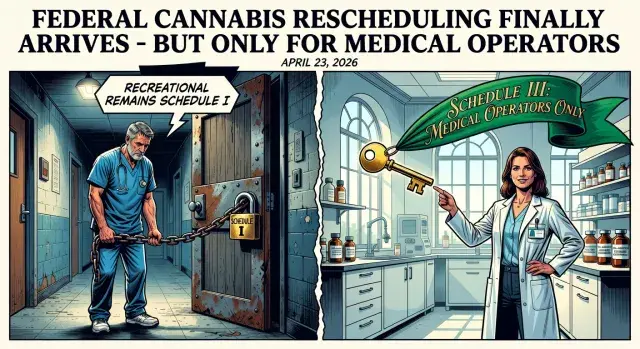
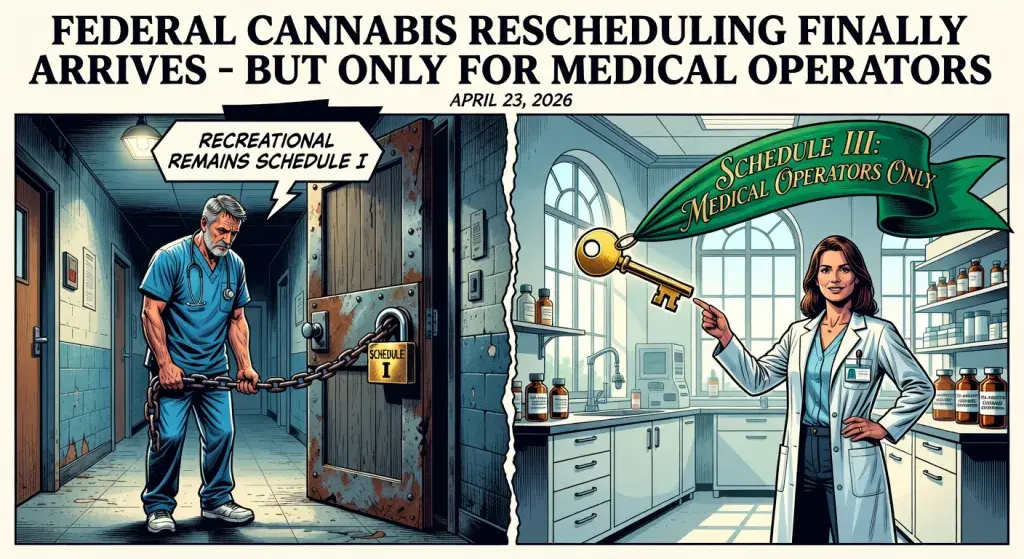
On April 23, 2026, the Department of Justice placed state-licensed medical cannabis into Schedule III of the Controlled Substances Act, ending decades of uniform federal prohibition for an industry that serves millions of patients. The move is real, it is immediate, and it is deliberately narrow. Recreational cannabis remains Schedule I. The broader rescheduling question now heads to an expedited administrative hearing set for late June.
What the Order Actually Does
Two categories of cannabis products now sit in Schedule III. The first - FDA-approved drug products containing marijuana or its derivatives - is small and largely symbolic; few such products exist. The second is the one that matters: cannabis and cannabis-containing products held under a qualifying state medical license. If you're a state-licensed medical operator, your product is no longer in the same federal category as heroin. If you're an adult-use dispensary in Colorado or California, nothing has changed. Not yet.
The legal mechanism here is worth understanding. The DOJ invoked Section 811(d)(1) of the CSA - a treaty-based pathway tied to U.S. obligations under the Single Convention on Narcotic Drugs. This is the same authority the DEA used in 2018 to place certain FDA-approved CBD drugs in Schedule V. The key advantage: it bypasses the standard notice-and-comment rulemaking and evidentiary hearings that have stalled broader rescheduling for years. The Order acknowledges the August 2023 HHS recommendation that cannabis belongs in Schedule III based on abuse potential and dependence characteristics, but pointedly notes those scientific findings aren't legally required under this treaty exception. In short, the DOJ found a door that was already unlocked.
What's tightly excluded is just as telling. Synthetic THC stays Schedule I. Unlicensed bulk cannabis stays Schedule I. Hemp defined under the 2018 Farm Bill is unaffected. And recreational cannabis - regardless of what any state legislature has done - remains fully prohibited at the federal level.
The Tax Relief Is Enormous, and Complicated
For medical operators, the most consequential effect is immediate: relief from Section 280E of the Internal Revenue Code. For years, 280E has been a slow financial asphyxiation. Because cannabis was Schedule I, businesses couldn't deduct ordinary expenses - rent, payroll, marketing, utilities. Some operators faced effective tax rates approaching or exceeding 75%. That era, for qualifying medical businesses, ended on April 22, 2026.
The Order goes further, directing Treasury to consider retroactive relief for prior tax years. The precise scope of that relief is unknown, but the signal is clear enough that operators should already be talking to their tax professionals. Amended returns, protective claims, systems to segregate deductible medical costs from non-deductible adult-use costs - all of this needs attention now, not after Treasury publishes formal guidance. For unitary businesses running both medical and recreational lines, the accounting complexity will be substantial. The window for strategic positioning is open, and it won't stay open indefinitely.
DEA Registration and the Preservation of State Frameworks
The Order creates an expedited DEA registration pathway for medical cannabis facilities, piggy-backing on existing state licensing infrastructure. State credentials serve as conclusive evidence of authorization. Early applicants can continue operating under state licenses during federal review. And here's a detail that could reshape industry logistics: DEA-registered facilities may be able to transport medical cannabis in interstate commerce and conduct federally sanctioned medical research.
One quiet but significant design choice - the Order preserves the physician-recommendation model that state medical programs already use. Patients won't need traditional prescriptions. Dispensaries won't need to become pharmacies. The federal framework is built on top of state systems, not instead of them.
The Broader Rescheduling Process Restarts - This Time with Deadlines
The second half of the announcement concerns all cannabis, not just medical. And the procedural backstory is a mess. The original notice of proposed rulemaking landed in May 2024, drew roughly 43,000 public comments, and then went nowhere. The chief administrative law judge raised concerns about alleged improper ex parte communications between DEA leadership and rescheduling opponents, canceled the hearing, stayed all proceedings - and then retired in August 2025, leaving DEA without a sitting ALJ for any matter. Status reports filed through early 2026 confirmed total paralysis.
That process has been formally terminated. A new administrative hearing begins June 29, 2026, with firm procedural deadlines. If it concludes successfully, the resulting rule would extend Schedule III status to adult-use cannabis - with all the downstream tax, banking, research, and capital markets implications that carries.
The Order will face legal challenges; more than two dozen Republican lawmakers have publicly opposed rescheduling. Banking and anti-money laundering questions remain unresolved. Federal criminal penalties tied to cannabis quantities are unaffected. But for an industry long accustomed to Washington's paralysis, this is the most concrete federal action in a generation. Half a loaf - maybe. But it's real bread.