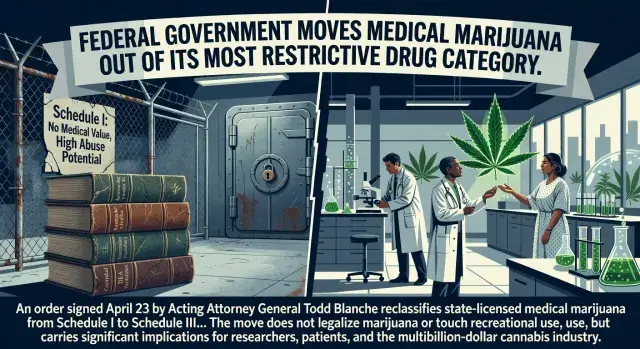
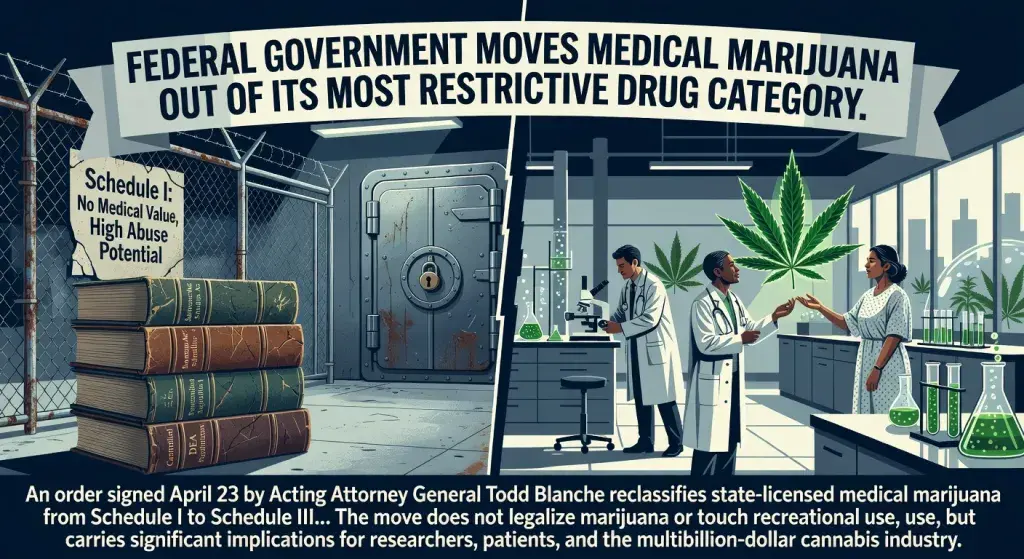
For more than half a century, the federal government treated marijuana the same as heroin. That just changed - at least partly. An order signed April 23 by Acting Attorney General Todd Blanche reclassifies state-licensed medical marijuana from Schedule I to Schedule III under the Controlled Substances Act, a shift that carries significant implications for researchers, patients, and a multibillion-dollar cannabis industry that has long operated under a punishing federal tax regime.
The move does not legalize marijuana. It doesn't touch recreational use. But what it does is substantial enough to warrant close attention.
What Schedule III Actually Means
Since the Controlled Substances Act was enacted in 1970, marijuana has sat in Schedule I - the category reserved for drugs deemed to have no accepted medical use and a high potential for abuse. Its neighbors there include heroin, LSD, and MDMA. The classification was always contentious, especially as state after state moved to legalize medical cannabis. Forty states now permit it in some form; 24 states and Washington, D.C., allow recreational use.
Schedule III is a different world. Drugs in this category - ketamine, anabolic steroids, Tylenol with codeine - are recognized as having legitimate medical applications and a moderate-to-low potential for dependence. The reclassification applies only to state-regulated medical marijuana programs and FDA-approved products containing marijuana. Recreational cannabis remains exactly where it was under federal law.
Here's the catch: the rescheduling doesn't harmonize federal and state frameworks in any comprehensive way. It carves out a narrow lane. But that lane matters.
The Research Bottleneck, Loosened
For years, scientists studying cannabis have faced bureaucratic friction that bordered on the absurd. Prolonged licensing procedures. Strict security protocols - including, as Harvard Medical School psychologist Staci Gruber told Science, the requirement to store cannabis in safes bolted to the floor. These constraints didn't just slow research; they shrank the scale of studies that could be conducted at all.
"It would be terrific to have more empirically sound data," Gruber said - a politely understated way of describing a situation where the federal government simultaneously classified a substance as having no medical value and made it extraordinarily difficult to study whether it had medical value.
Schedule III status should reduce those barriers meaningfully. Researchers will still need oversight and approval, but the licensing gauntlet becomes less onerous. Larger clinical trials become feasible. That matters because the existing evidence base for cannabis - while growing - remains thinner than it should be for a substance used by millions of Americans.
Money, Taxes, and the Business of Cannabis
The economic implications are blunt and immediate. Under a provision of the Internal Revenue Code known as Section 280E, businesses trafficking in Schedule I or II substances cannot deduct ordinary business expenses on their federal taxes. For state-legal cannabis companies, this has meant effective tax rates that are punitive by any standard - sometimes exceeding 70 percent.
Schedule III eliminates that problem. Medical marijuana businesses operating under state licenses will now be able to claim deductions and credits like any other legitimate enterprise. Brian Vicente, a marijuana rights attorney, told CNN the change could generate "billions of dollars in new economic activity" and "tens of thousands of new jobs." Whether those numbers land precisely is debatable; that the financial relief will be substantial is not.
Not everyone is celebrating. Kevin Sabet, who heads Smart Approaches to Marijuana, argued to the Associated Press that the rescheduling amounts to "giving a tax break to 'Big Weed' and sending a confusing message about marijuana's harms." It's a fair concern - the messaging is inherently muddled when a substance remains federally illegal for recreational use but federally reclassified as moderate-risk for medical use. Confusion, in drug policy, is rarely harmless.
What Comes Next
This order isn't the endgame. An expedited hearing beginning in June will consider broader rescheduling of cannabis - potentially extending beyond the medical-only scope of the current action. The Biden administration attempted something similar in 2023; the Drug Enforcement Agency agreed in principle to loosen restrictions, but the finalizing hearing never materialized. Whether this administration follows through remains to be seen.
The rescheduling also arrives alongside a separate executive order aimed at accelerating access to psychedelic medication for serious mental illness - a move experts have characterized as largely symbolic. Taken together, the signals suggest an administration willing to adjust federal drug classification, though the depth of that willingness is still being tested.
What's clear is this: the five-decade status quo - marijuana as Schedule I, full stop - has cracked. The practical consequences for research, taxation, and medical access are real. The policy contradictions, though, remain very much intact.