
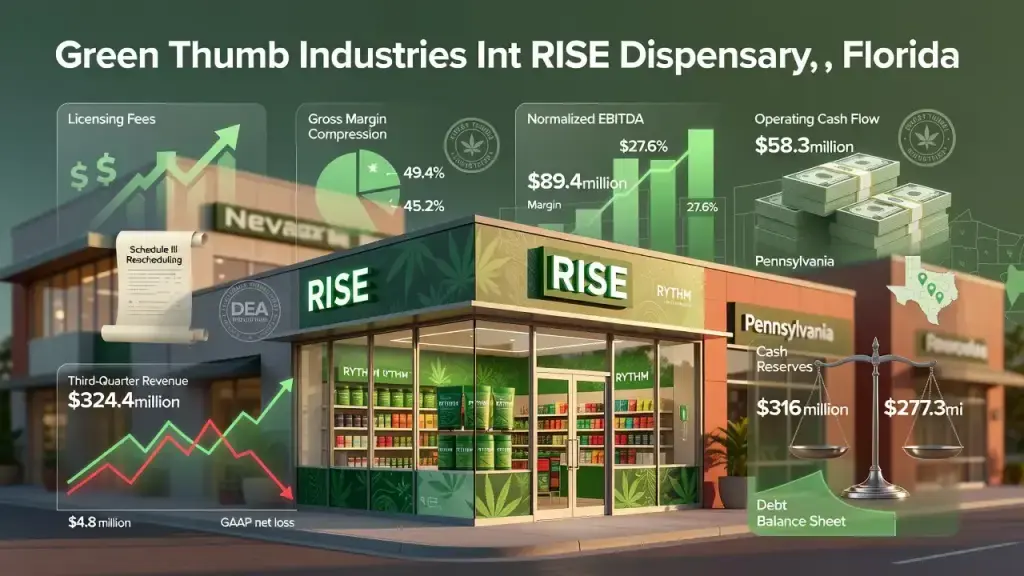
Green Thumb Industries posted third-quarter revenue of $324.4 million, up 11.3% year over year, yet closed the period with a GAAP net loss of $4.8 million. The swing from the prior year's $23.3 million profit wasn't driven by weaker stores. It came from a mix of licensing costs, rising overhead, and a comparison against a one-time gain the company booked a year earlier on an intellectual-property sale. For a multi-state operator this size, the numbers tell a story familiar to anyone watching cannabis retail margins compress even as top-line growth holds up.
Growth at the register, pressure below the gross-margin line
Retail revenue rose 10.1% and consumer packaged goods climbed 16.0%, and comparable-store sales turned positive at 3.0% after a soft second quarter. That's a real signal - same-store growth is the metric operators watch most closely, since it strips out the effect of new door openings and shows whether existing locations are actually gaining traction against price compression and local competition. Green Thumb added six RISE Dispensaries across Florida, Nevada, and Pennsylvania during the quarter, continuing a retail-footprint expansion that has made it one of the more visibly aggressive operators in the adult-use and medical channel.
Here's the catch: gross margin fell to 45.2% from 49.4%, largely because of $15.8 million in RYTHM brand licensing fees embedded in cost of goods sold. Licensing arrangements like this are common in cannabis, where companies often separate brand ownership from the operating entity for structural and tax reasons, but the fees still hit the income statement the same way any cost of goods would. Selling, general and administrative expenses also rose, to $121.7 million from $107.3 million, pulling operating income down to $25.1 million from $36.7 million. Put together, revenue growth alone wasn't enough to offset the cost side of the ledger.
Normalized EBITDA climbs even as GAAP profit disappears
Normalized EBITDA, which adds back brand license fees along with stock compensation and other non-cash items, rose to $89.4 million from $80.2 million, with margin ticking up to 27.6%. That gap between a GAAP loss and a rising non-GAAP earnings figure is worth sitting with. Non-GAAP metrics can be useful for comparing operating performance across periods with different one-time items, but they also strip out real cash costs like the licensing fees driving the margin compression. Investors reading the headline loss number and the headline EBITDA number side by side are getting two different pictures of the same quarter, and both are legitimate - they just answer different questions.
Operating cash flow of $58.3 million and a cash balance of $316.0 million against $277.3 million in total debt suggest the balance sheet has room to absorb a loss quarter without triggering liquidity concerns. The board's decision to extend its repurchase authorization - up to $50 million through September 2027 - reads as a signal of confidence in underlying cash generation, though buybacks remain forward-looking commitments, not completed transactions.
Consolidation and federal shifts complicate the comparison ahead
An amendment affecting RYTHM, Inc. convertible notes and pre-funded warrants takes effect October 10, 2026, triggering consolidation of that entity into Green Thumb's financial statements going forward. The company has been clear that this involves no purchase of securities and no change in ownership interest - but it does mean fourth-quarter results won't line up cleanly against prior periods, something analysts and operators tracking the stock will need to account for.
Meanwhile, the company received DEA registrations tied to certain state medical cannabis licenses following the rescheduling of medical cannabis to Schedule III, a regulatory shift still working its way through the industry's compliance infrastructure. Schedule III status doesn't legalize cannabis federally or resolve banking restrictions, but it does introduce new federal registration requirements that licensed operators are now navigating state by state. Combined with pending questions on hemp-derived THC rules and a conditional license tied to the company's planned entry into Texas, the regulatory picture remains unsettled - and that uncertainty is part of why a quarter with real sales growth can still close in the red.