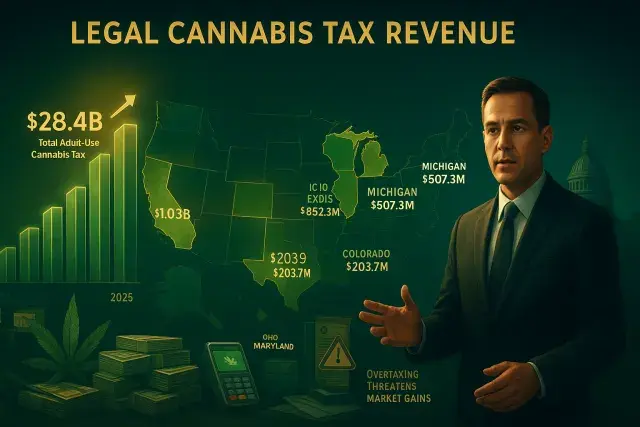
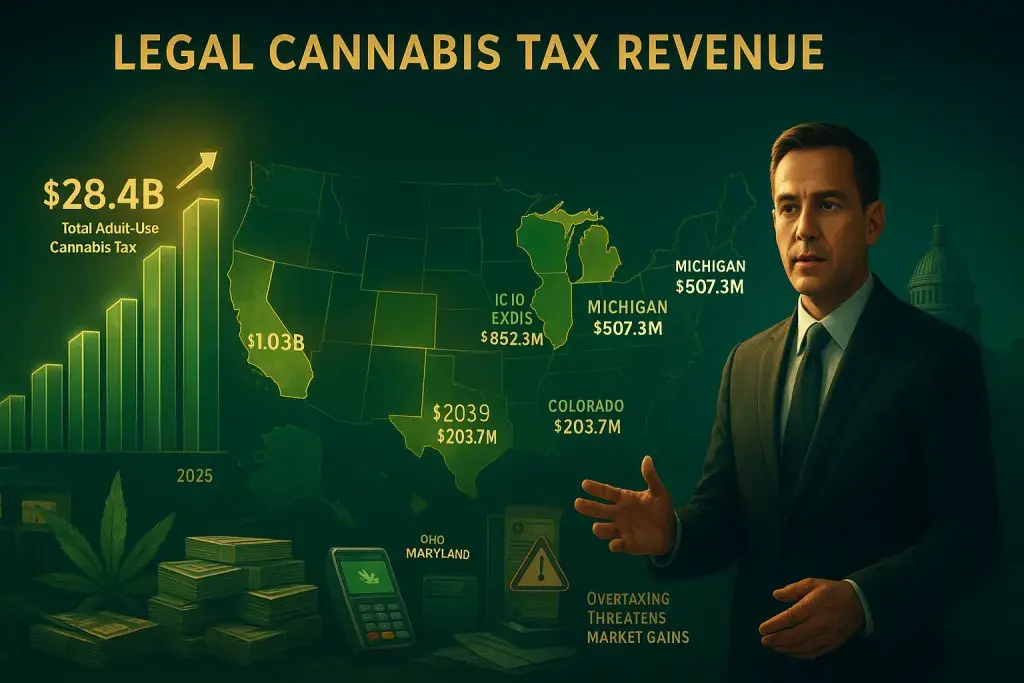
Adult-use cannabis has now delivered more than $28.4 billion in state tax revenue since recreational markets first opened for business over a decade ago, according to a new analysis from the Marijuana Policy Project. In 2025 alone, adult-use sales pushed $4.5 billion into state coffers - the highest single-year total on record, edging past 2024's $4.4 billion and marking a decade of compounding fiscal impact that few early advocates could have projected with confidence.
The numbers carry real operational weight for licensed businesses across the supply chain. States with established markets - California, Illinois, Michigan, Washington - now collect cannabis excise tax revenues that, in several cases, exceed what they pull from alcohol. For operators managing point-of-sale systems, wholesale pricing structures, and compliance logs in those states, that fiscal scale translates directly into regulatory scrutiny and budget-driven policy decisions. In Oregon, where the adult-use market has matured significantly and retailers have invested heavily in tools like marijuana pos oregon technology to manage inventory and tax reporting, the state collected $143.7 million in recreational cannabis taxes in 2025 - a figure that gives regulators ongoing political cover to maintain and tighten compliance frameworks. The MPP analysis does not include medical marijuana revenue, licensing fees, income taxes from industry workers, or taxes paid to federal and municipal governments, so the aggregate economic footprint of the licensed industry runs considerably higher than the headline number.
Seven States, Three Half-Billion-Dollar Markets
Seven states each cleared $200 million in adult-use cannabis tax collections last year. Three crossed the $500 million threshold. California alone brought in just over $1 billion - a milestone figure, even accounting for the state's notoriously high excise and cultivation tax structure, which has been a persistent source of operator frustration. Illinois ($552.6 million) and Michigan ($507.3 million) rounded out the top tier. Washington, at $495.8 million, came close. Massachusetts, Arizona, and Colorado each topped $200 million.
What's striking here is the breadth. New markets like Ohio ($130.6 million), Maryland ($90.4 million), and Missouri ($137.4 million) are already generating nine-figure revenues in early operational years. Delaware and Minnesota, both of which launched adult-use sales in 2025, posted modest but real numbers - $3.1 million and roughly $2 million respectively - consistent with what any new retail market looks like before license buildout and consumer habit formation take hold. New York, still working through a slow and contested rollout, collected $173.4 million.
The Overtaxation Problem Isn't Theoretical
MPP executive director Adam J. Smith said what many licensed operators have been saying for years: overtaxing adult-use cannabis is self-defeating. When the legal price point rises too far above what the illicit market charges, consumers don't quit - they just stop buying compliantly. That has direct consequences for dispensary revenue, wholesale pricing power, and brand SKU movement. It also undermines the public safety argument that legalization was supposed to deliver, since unregulated product carries no testing requirements, no compliant packaging standards, and no chain-of-custody documentation.
California is the clearest case study. Despite crossing the $1 billion tax mark in 2025, the state has spent years grappling with an illicit market that licensed retailers cannot outprice under the current tax structure. Operators there have pushed hard for tax relief, arguing that excise burdens erode margins to the point where even well-run dispensaries struggle to stay solvent. The tension isn't unique to California - it's a structural issue in any state that treats cannabis tax policy as a revenue maximization exercise rather than a licensed market stabilization tool.
Budget Relief, With Caveats
The MPP report frames cannabis tax revenue as meaningful relief for strained state budgets, particularly as federal funding pressures mount. In mature markets, adult-use cannabis taxes represent between 0.25% and 1.5% of total state budgets - not transformative on their own, but not trivial either, especially when directed toward specific line items. States have allocated cannabis tax dollars to Medicaid, K-12 education, school construction, affordable housing, road infrastructure, behavioral health services, alcohol and drug treatment, veterans' programs, job training, and conviction expungement - among other uses.
There is, however, a complication worth noting. A separate economic analysis released the same week by Vangst and Whitney Economics found that 2025 marked the first year of year-over-year decline in national cannabis sales revenue since recreational markets launched in 2014. Tax receipts hit a record high while underlying sales contracted. That divergence likely reflects a combination of factors: price compression at the wholesale and retail level, new state markets adding tax volume even as per-unit prices fall, and ongoing competition from non-compliant supply. For multi-state operators, investors, and B2B suppliers watching margin trends, that's the data point that deserves the most careful attention - not the headline revenue number, but the gap between what states collect and what the licensed industry actually earns.