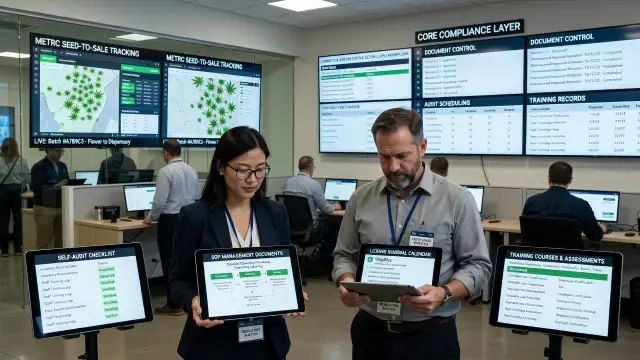
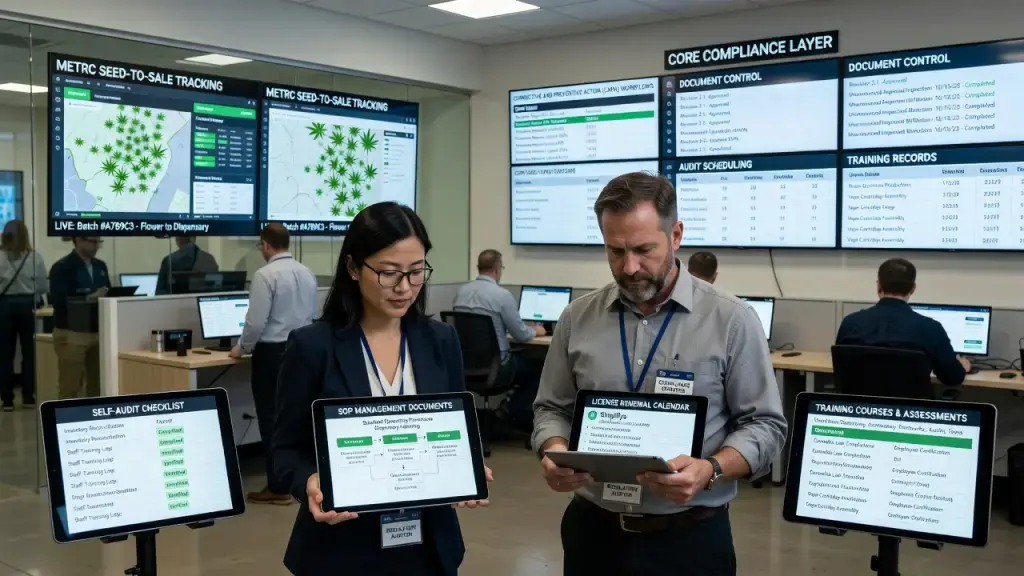
Inventory tracking used to be the whole story for cannabis compliance software. Not anymore. A separate category has taken shape around a narrower, arguably harder problem: proving to a regulator, an auditor, or a bank that a licensed operator is actually following the rules it agreed to follow when it got licensed. Seed-to-sale and state track-and-trace reporting - METRC chief among them - now sit on their own page. What's left is the paperwork trail that keeps a dispensary standing when an inspector walks in unannounced.
Self-audits, SOPs, and the license-tracking problem
Here's the catch with cannabis licensing: the rules don't hold still. States amend regulations, renewal windows shift, and a single multi-state operator might be juggling dozens of licenses across jurisdictions with different renewal cadences and different documentation standards. Simplifya, based in Lakewood, Colorado, builds its platform around that reality - self-audits, SOP management, and license tracking bundled together so an operator isn't reconstructing its compliance history from email threads the night before an inspection. Rootwurks, out of Austin, takes a training-first angle, pairing courses with checklists and assessments developed alongside the cannabis law firm Vicente Sederberg. The logic is straightforward: an inspector doesn't just check your shelves, they check whether your staff can explain why the shelves are organized that way, and whether that explanation matches a written procedure on file.
Quality management isn't optional for manufacturers
Cannabis manufacturers - the companies pressing rosin, infusing gummies, or filling vape cartridges - face a quality-control burden that looks a lot more like food and pharma manufacturing than retail. QT9 sells a quality management system built for that world: document control, corrective and preventive action (CAPA) workflows, audit scheduling, training records. None of this touches inventory counts. It touches whether a batch recall, if one ever happens, can be traced cleanly back through a documented process rather than a shrug and a guess. Regulators care about that distinction. So do insurers, frankly, and so should any operator thinking about what happens after a lab test comes back with an unexpected result.
The counter is where compliance meets the customer
Purchase limits exist for a reason - they're a public-health guardrail, not a sales ceiling dreamed up to annoy budtenders. The trouble is enforcing them when the same customer visits three dispensaries in one afternoon, or the same store twice in one day. Patronscan's ID scanning addresses that gap by flagging repeat visits at the point of sale, giving staff a way to respect daily purchase limits without relying on memory or trust. That's a small piece of software doing real regulatory work: age verification and purchase-limit enforcement are two of the few consumer-protection measures state regulators actually check line by line.
Why banks need their own compliance layer
A cannabis business keeps its checking account for one reason, mostly: the bank can show its own regulator that due diligence happened and keeps happening. That's a heavier lift than normal commercial banking, since cannabis remains federally illegal even where state-licensed. Green Check, based in Bonita Springs, Florida, along with Shield Compliance in Seattle and RiskScout, give banks and credit unions tools for onboarding cannabis accounts, ongoing monitoring, and the reporting trail examiners expect to see. CRB Monitor, out of Nashville, maintains a database of cannabis licenses and beneficial ownership records used for know-your-customer checks. An operator opening a business account may never see these platforms directly - they're bank-side - but the paperwork an operator submits at onboarding often feeds straight into one of them.
Put together, none of this software moves product or counts units. It builds a record. In a sector where banking access is scarce and license renewals carry real financial stakes, that record is the asset.