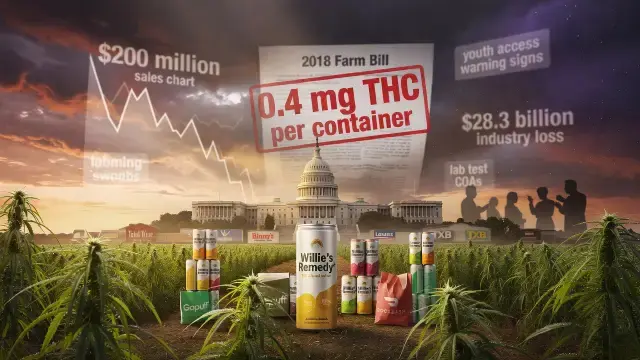
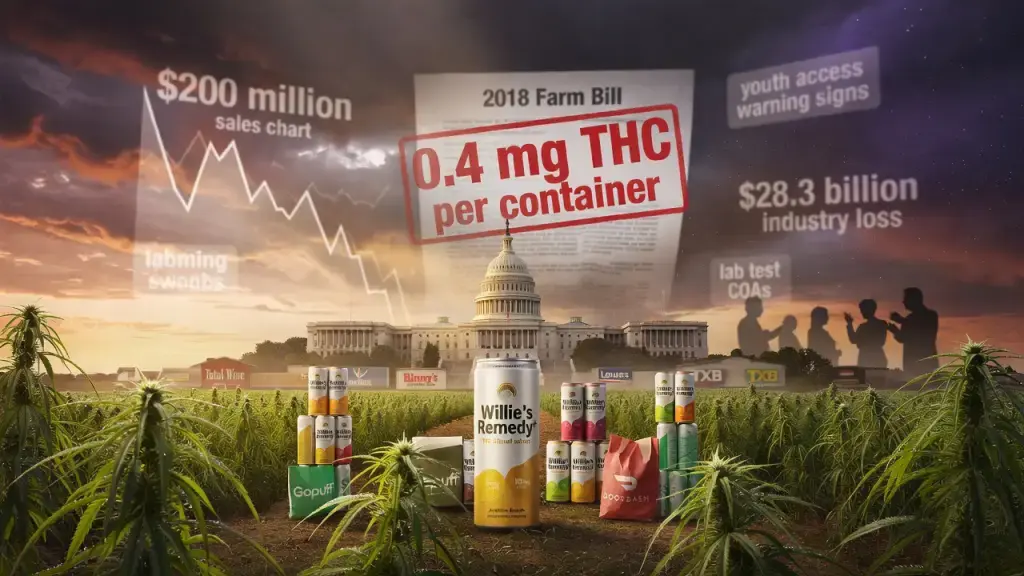
A federal crackdown on intoxicating hemp products set to take effect December 11 could wipe out one of the hemp beverage category's biggest success stories. Willie's Remedy+, the THC-infused seltzer and tonic line Willie Nelson runs with California beverage maker JuneShine Brands, is on pace for roughly $200 million in sales this year - and could be forced to shut down if Congress doesn't intervene first.
A potency threshold that reshapes the category
The new rule, tucked into the spending package that ended last November's government shutdown, redefines legal hemp to exclude any finished product with more than 0.4 milligrams of total THC per container. That's not a typo - it's milligrams, not percentage points, and it's a fraction of what a typical THC drink delivers. Willie's Remedy+ sells servings at 5 milligrams and 10 milligrams, well above the new ceiling. For a brand built on dosed, repeatable servings, that's not a labeling tweak. It's an existential compliance problem.
The mechanism behind this entire industry traces back to the 2018 Farm Bill, which legalized hemp under a 0.3% delta-9 THC by dry weight standard. Beverage makers realized a canned seltzer is mostly water, so a full psychoactive dose could still clear that dry-weight threshold. That loophole built a roughly $1.5 billion annual hemp drink market. Under the new milligram-based cap, the math simply doesn't work anymore for most adult-use formulations.
What's at stake for operators and retail partners
JuneShine's co-founder and chief executive, Greg Serrao, has said the company would consider discontinuing the line entirely if lawmakers don't act. That's a notable statement from an executive overseeing a brand he's called "wildly profitable," with sales climbing from about $30 million in its first year to a projected $200 million now. The brand has expanded into Total Wine, Lowes Foods, Binny's Beverage Depot and convenience retailer TXB, plus delivery platforms Gopuff and DoorDash - all channels that would need to pull product fast if the ban takes hold on schedule.
For retailers and distributors stocking hemp beverages, the exposure isn't abstract. SKUs built around 5mg and 10mg servings sit outside the new legal definition, which means inventory on shelves could become unsellable overnight unless reformulated or pulled. Wholesale menus, POS category tags, and compliant packaging specs tied to these products would all need rework on a compressed timeline - not the kind of operational pivot most beverage distributors can execute in weeks.
Congress hasn't settled on a fix
Two legislative paths are in motion, and neither has cleared committee. Senators Amy Klobuchar and Tim Sheehy are drafting bridge legislation that would restrict sales to adults 21 and over while a permanent federal framework gets written - essentially an age-gating patch rather than a full regulatory overhaul. Separately, Representatives Andy Barr and Angie Craig introduced the Lawful Hemp Protection Act, which would tax and regulate hemp drinks along the lines of alcohol, including excise structures and distribution controls more familiar to beer and spirits companies than to hemp brands.
Senator Mitch McConnell, who authored the original 2018 hemp provision, is now the force behind tightening it, citing concerns about youth access to intoxicating products. That tension - the same lawmaker who opened the loophole now moving to close it - says a lot about how unregulated this product category has remained for seven years. No federal age verification standard, no uniform potency cap, no consistent lab testing or COA requirement across state lines. Nelson himself has pushed for that middle ground. "Banning hemp won't solve problems. Smart regulation will," he said in February, arguing for oversight rather than elimination.
Broader implications for the hemp THC market
Willie's Remedy+ is far from alone in its exposure. Whitney Economics estimated in September that the broader hemp THC industry - gummies, vapes, drinks - stands to lose $28.3 billion in retail revenue under the ban. Cheech & Chong's holding company has said roughly 80% of its business comes from products that would fall under the new restrictions. That scale of disruption points to a consumer-safety argument on both sides: proponents of the ban cite youth access and inconsistent dosing across an unregulated market, while brands argue that a sudden shutdown pushes consumers toward unregulated, untested alternatives with no labeling standards at all. Either way, the December 11 deadline is forcing operators across the hemp beverage supply chain to plan for a worst-case scenario while hoping Congress finds a workable middle path.