
Low-Earth orbit satellite service has moved from fallback option to genuine business consideration - and the data behind that shift tells a more specific story than most carrier pitches acknowledge. Surveys conducted by Recon Analytics across nearly 10,000 U.S. businesses in 2025 and 2026 show where the real demand is, where the channel friction lives, and why Starlink's commercial role may look quite different in three years than it does today.
The Coverage Gap Is Real, but It Skews Large
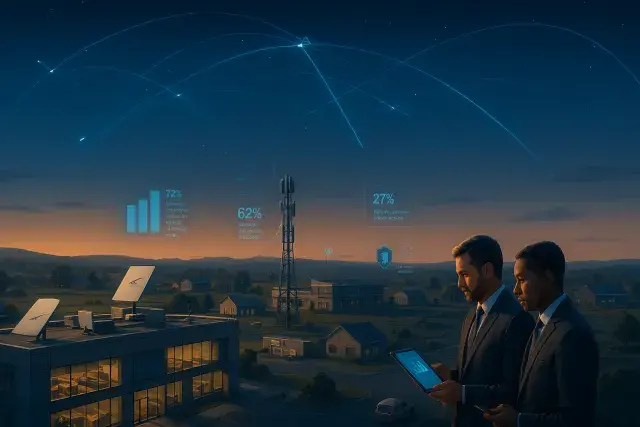
Starlink's clearest direct-sales argument in business markets is geographic. Go where fiber doesn't. That sounds straightforward, and for multi-location enterprises, it largely is. In Recon Analytics survey data collected between March and April 2026, 72% of large businesses said they would work with a smaller ISP if that ISP could deliver Starlink connectivity in places where they currently had no coverage. Midsize businesses came in at 62%. Small businesses: 44%.
That 28-point spread between large and small isn't a rounding error - it reflects a structural difference in how each segment experiences the problem. A business running 50 locations almost certainly has some of those sites sitting outside fiber and cable reach. A single-location rural operation either has the gap or it doesn't. For large enterprises managing a dispersed footprint, a Starlink-augmented ISP solves something concrete. For small businesses, the need is real but narrower.
The second data point sharpens the picture. Among 1,483 businesses that reported dissatisfaction with their current internet provider but had not switched, 27% of small businesses said the reason was simple: no other options existed. For midsize businesses, that figure dropped to 11%. For large businesses, just 6%. That 27% is where Starlink's direct pitch carries the most weight. A business that is stuck - genuinely stuck, not just indifferent - is not a competitive displacement conversation. It's a vacancy that nobody else is filling.
Where Starlink Stops Short With Enterprise Accounts
Here's the catch for Starlink's ambitions beyond underserved rural markets: larger businesses don't just buy connectivity. They buy managed security, SD-WAN, direct cloud on-ramps, SLA-backed uptime guarantees, and unified support structures. Starlink, at present, provides a pipe. A fast, low-latency pipe - but a pipe. The gap between "connectivity provider" and "full-stack managed services vendor" is wide, and closing it takes more than a better antenna.
That product boundary matters for how Starlink fits into enterprise procurement. A CFO at a 200-location retailer isn't evaluating Starlink against a fiber carrier; she's evaluating it as a component of a broader managed WAN arrangement. That's a fundamentally different buying motion, and it's one where Starlink's current portfolio leaves it dependent on partners to complete the offer.
The Backup Case Runs Through Carriers, Not Starlink
Satellite-as-failover is the other major business opportunity - and it's a structurally different one. Starlink doesn't need to win the primary internet relationship here. It just needs to be available when the primary line goes dark. AT&T and Verizon already use their fixed wireless access networks for exactly this function, providing FWA failover when a primary wired connection fails. Satellite can do the same in areas where FWA coverage is thin or where FWA itself is the primary technology.
Recon Analytics tested this directly. Between April 1 and April 29, 2026, the firm asked businesses whether satellite backup would make FWA more attractive as a primary connection. Large and midsize businesses came in at 34% each. Small businesses landed at 24%. What's worth noting is when that data was collected: it predates T-Mobile's SuperBroadband announcement in May 2026, which lists Starlink failover as a core feature. The demand was already there before the product launched.
In practice, though, the FWA backup opportunity mostly runs through carrier channels - not through Starlink's own sales team. T-Mobile holds the customer relationship inside SuperBroadband. Comcast Business holds it in its own managed connectivity offering, which also incorporates Starlink. That's a lower-margin infrastructure role, not a direct-service relationship. The scale upside is real; carrier distribution reaches enterprise accounts that Starlink cannot efficiently serve on its own. But Starlink accepts a position as a supplier, not a provider - and those two positions carry very different long-term economics.
The Partnership Question Has an Expiration Date
Nothing in Starlink's commercial arrangements with T-Mobile or Comcast formally bars it from eventually competing directly in markets where those carriers currently own the customer. The limiting factor today is product fit, not contract language. That distinction matters when evaluating how durable these partnerships actually are.
A further complication: the recently announced joint venture between AT&T, T-Mobile, and Verizon on direct-to-device satellite communications could put real strain on Starlink's relationship with T-Mobile. If that venture gains traction, T-Mobile's incentive to feature Starlink as a flagship failover solution weakens. That pressure, in turn, could push Starlink toward a more direct commercial posture with enterprise buyers - accelerating exactly the channel conflict its carrier partners would prefer to avoid.
The satellite-to-business connectivity story isn't finished. But the current chapter is less about Starlink disrupting the enterprise market and more about it finding where the edges of the existing market go unserved - and deciding, over time, whether staying at the edge is enough.