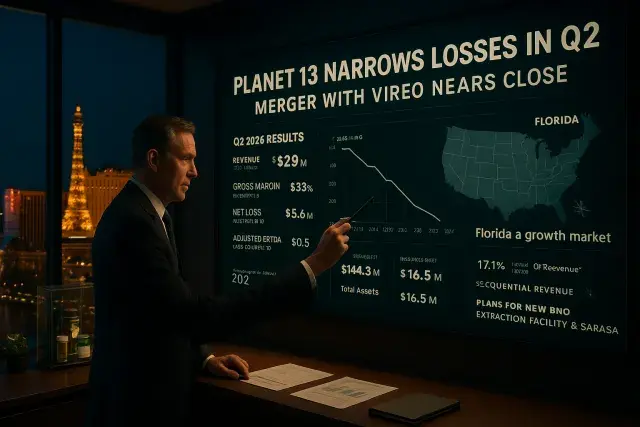
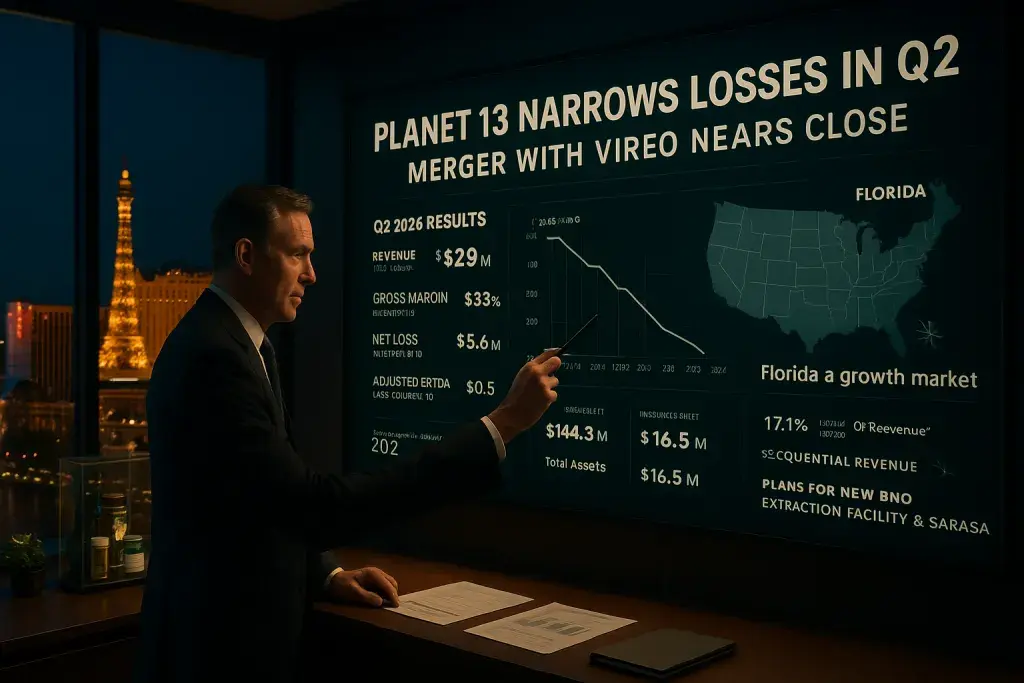
Planet 13 Holdings reported second-quarter 2026 revenue of $22.9 million, down 14.9% from the prior-year period, as the multi-state operator absorbed the fallout from exiting California retail and wholesale operations. Yet the numbers beneath the top line tell a more interesting story: gross margin expanded to 53.9%, net loss narrowed to $5.6 million from $13.3 million a year earlier, and Adjusted EBITDA loss shrank to $0.5 million. The results land just weeks before Planet 13's pending merger with Vireo Growth is expected to close, and the company opted to skip its usual earnings call given the transaction in progress.
Margin Gains Mask a Shrinking Footprint
Here's the catch with a quarter like this one: revenue fell, but the business actually got healthier on a unit-economics basis. Exiting California - a market where wholesale pricing had compressed to the point of squeezing out profitability for smaller vertically integrated players - removed a drag on margin even as it cut top-line sales. Total expenses dropped 17.7% to $15.2 million, reflecting cost-cutting and procurement initiatives that operators across the sector have leaned on as price compression persists in mature adult-use markets like Nevada. A $1.0 million reduction in Planet 13's inventory reserve for Florida distillate, tied to rising in-state sales working down excess stock, also flattered gross margin; strip that out and margin was 49.5%, still a meaningful improvement year over year.
Florida stood out as the bright spot, with revenue up 17.1% sequentially. That's notable because Florida's medical-only market has forced operators to compete on retail experience and product breadth rather than adult-use foot traffic. Planet 13's OMMU approval for a BHO extraction facility in May and its planned Sarasota store expansion suggest the company is still building out vertical capacity in the state even as it retrenches elsewhere - a bet that scale within Florida's regulated supply chain will pay off as the medical market matures.
What the Vireo Merger Signals for Multi-State Operators
The July 27 announcement of a definitive merger agreement with Vireo Growth reframes how to read these results. Bob Groesbeck's comments make the strategic logic explicit: the cannabis retail market increasingly rewards scale, purchasing power, and balance-sheet strength to absorb continued price compression. That's not a controversial claim in this industry. Multi-state operators have spent years discovering that vertical integration alone doesn't protect margin when wholesale prices in a saturated market keep sliding, and 280E tax exposure keeps eating into what little net income exists. Combining with Vireo gives Planet 13 shareholders equity in a larger entity with presumably broader distribution and more negotiating leverage with suppliers - though the deal still needs to close before any of that plays out operationally.
For operators and investors watching the space, the filing offers a useful data point on how a mid-sized MSO manages contraction. Planet 13 cut costs, exited an unprofitable market, and improved margin discipline - all before consolidation even took effect. That sequencing matters for compliance and finance teams elsewhere in the industry: it suggests the operational playbook of tightening SKU management, renegotiating procurement, and pruning underperforming markets can stabilize a balance sheet even amid falling revenue, buying time for a larger structural fix like a merger.
Balance Sheet and What Comes Next
Total assets fell to $144.3 million from $152.3 million at year-end 2025, while liabilities rose slightly to $105.5 million. Cash and restricted cash ticked up modestly to $16.5 million. None of these figures suggest crisis, but they don't suggest abundant flexibility either - which is precisely why the merger timeline matters so much to shareholders, employees, and the patients and customers who rely on Planet 13's dispensaries in Nevada, Illinois, and Florida. The company's decision to forgo a conference call this quarter, citing the pending transaction, is a signal in itself: management appears focused on execution rather than narrative-building, with the Vireo deal now the central variable determining what Planet 13 looks like a year from now.