The Texas Senate Committee on Health and Human Services held a public hearing this week aimed squarely at building the legislative case for a statewide ban on consumable hemp-derived THC products. No vote was taken - the session was framed as an information-gathering exercise - but the direction was unmistakable. Committee members relied heavily on anti-drug rhetoric, invited a panel dominated by prohibition advocates, and at least one senator confirmed he will file a ban bill when the legislature reconvenes.
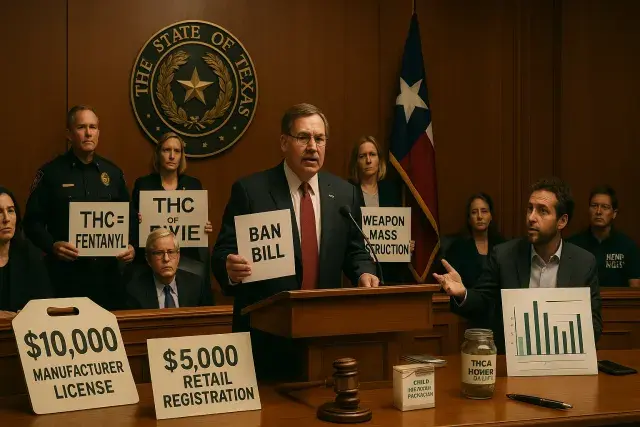
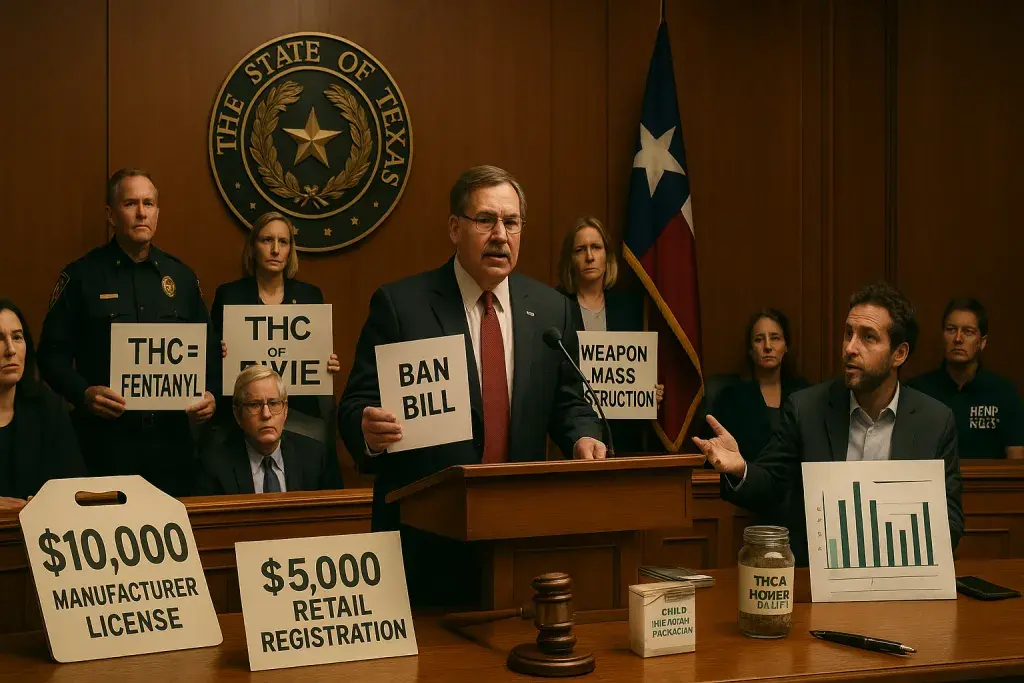
For hemp retailers and compliant operators in Texas, the hearing is the latest signal in a regulatory environment that has been tightening fast. DSHS rules that took effect March 31 already banned THCA flower and pre-rolled joints by requiring that total THC - including levels activated only upon combustion - remain under the 0.3% federal threshold. Licensing fees were restructured dramatically: manufacturers now face a $10,000-per-facility fee, up from $258, and retail registrations jumped from $155 to $5,000. Those are compliance cost increases that will force smaller operators to make hard decisions about staying open. Operators in other regulated cannabis markets tracking similar regulatory shifts can learn more about how compliant retail infrastructure adapts to sudden licensing and operational changes.
What's striking here is how openly the fee structure was described as an instrument of closure, not compliance. Sen. Charles Perry, R-Lubbock, said at the hearing that he hoped the cost of doing business would force most hemp retailers out of operation entirely. That is a significant admission. Most regulatory frameworks justify licensing fees on the basis of enforcement cost recovery or public health administration. Stating on the record that the goal is to make a legal industry economically nonviable is a different thing - and it creates real legal exposure for the state's position if challenged in court.
A Stacked Panel and a Missing Public Comment Period
The committee did not open the floor to public comment, citing time constraints. The invited speakers, however, were not a neutral cross-section. Five of the experts called were known opponents of hemp-derived THC products. Allen Police Chief Steve Dye - who became publicly associated with hemp store raids - was invited to testify, as was Aubree Adams, director of Citizens for Safe and Healthy Texas, who compared THC to fentanyl as a "weapon of mass destruction." That comparison drew a direct rebuttal from Katharine Neill Harris, a drug policy fellow at Rice University's Baker Institute, who told the committee that conflating cannabis use with psychosis, homelessness, and youth academic failure misrepresents the clinical evidence.
Harris's point deserves more weight than it received in that room. There is a real distinction - one that matters for both policy and compliance - between saying THC elevates psychosis risk in individuals predisposed to such conditions and saying THC causes psychosis in otherwise healthy users. Blurring that line doesn't produce better regulation; it produces overbroad prohibition that fails to account for actual risk stratification. Her argument about treatment access was equally pointed: without affordable, accessible intervention options, mild substance use disorders progress. Prohibition without treatment infrastructure is not a public health strategy.
The Regulatory Ratchet Is Already Moving
The hearing didn't happen in a vacuum. Gov. Greg Abbott vetoed the legislature's attempted ban last summer and directed DSHS and the Texas Alcoholic Beverage Commission to strengthen oversight instead. The resulting DSHS rules - child-resistant packaging, updated labeling standards, third-party lab testing requirements, codified age-21 purchasing, and the fee increases - were a real regulatory escalation. The industry, to its credit, largely supported age verification and packaging reforms. The fee structure is a different matter.
For multi-location hemp retailers in Texas, $5,000 per retail registration adds up quickly across a store footprint. Smaller independents operating on thin margins in a market that hasn't had a clear regulatory floor until this year are the most exposed. The irony is that the operators most likely to exit under fee pressure are the licensed, compliant ones - the businesses that actually registered, updated their POS systems, pulled noncompliant SKUs off shelves, and absorbed testing costs. Unlicensed sellers don't file paperwork, and higher fees don't reach them.
What Operators Should Watch Before the Next Session
Perry's confirmed intention to file a ban bill when the legislature reconvenes means this isn't over. The legislative session provides another window for prohibition advocates to push what the governor declined to sign last time. Whether Abbott's posture holds under renewed legislative pressure is an open question - political contexts shift. Hemp industry operators and their legal counsel should be watching committee composition, tracking the bill's language when it drops, and documenting compliance investments made under the current DSHS framework.
The data cited by Sen. Lois Kolkhorst - nearly 1,900 newborns testing positive for THC at birth in fiscal 2025, up from roughly 1,550 the year prior - represents a legitimate public health concern that the industry cannot dismiss. Prenatal THC exposure is a documented medical issue. Operators who dismiss or minimize that data weaken their own credibility in a regulatory fight where credibility matters. The more defensible position, and the one Harris articulated, is that real health concerns require real regulatory solutions: honest labeling, enforced age restrictions, treatment access, and evidence-based policy - not a prohibition framework built on rhetoric from four decades ago.
The business question, plainly, is this: if a ban bill passes and Abbott signs it this time, what is the legal and operational wind-down process for licensed hemp retailers who invested in compliance under the current rules? That planning needs to start now, not after a bill is enrolled.