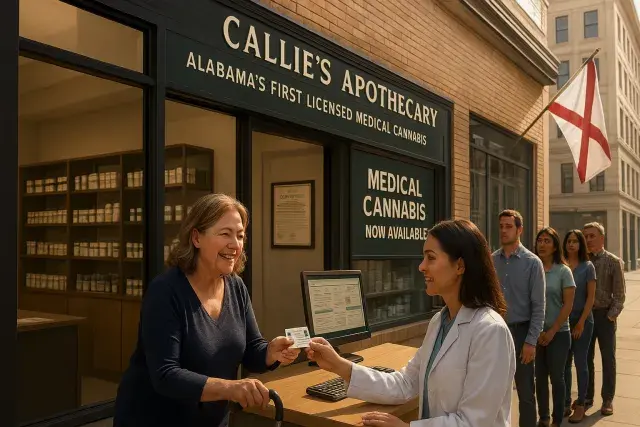
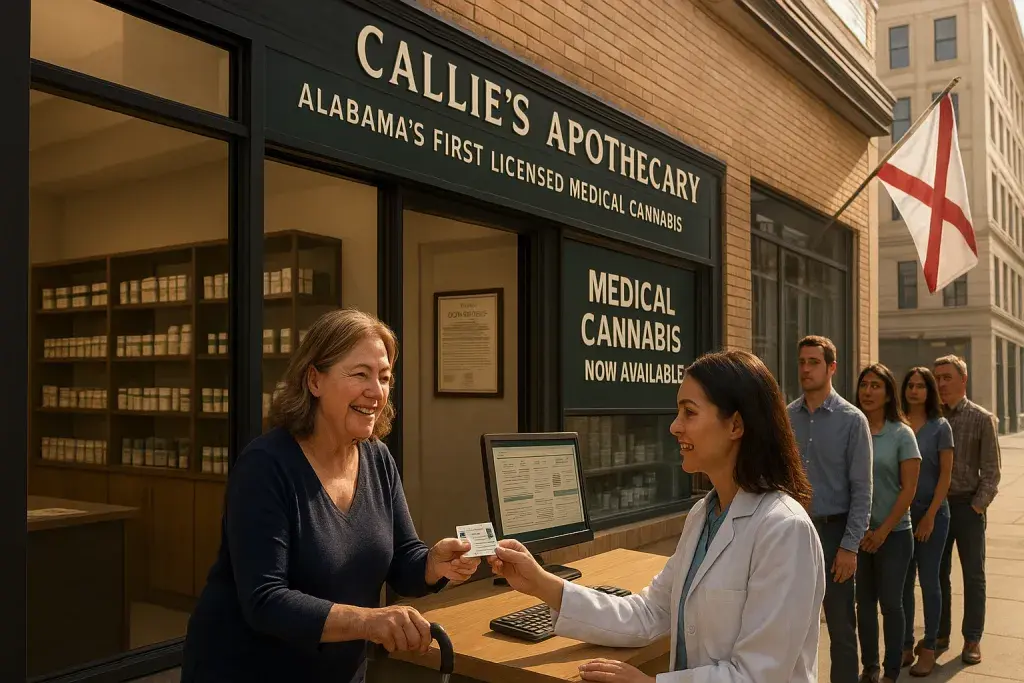
Medical cannabis was sold legally in Alabama for the first time this week, when Callie's Apothecary opened its doors in Montgomery - marking the end of a drawn-out licensing process that had kept patients waiting years after the state's enabling legislation passed. The moment is significant not just symbolically, but as a signal that Alabama's tightly controlled medical program is finally operational, with real inventory moving through a licensed supply chain and real patients presenting state-issued certifications at a point-of-sale counter.
The road here was anything but direct. Alabama became the 37th state to legalize medical cannabis when Gov. Kay Ivey signed the bill into law more than five years ago. Prolonged legal disputes stalled the Alabama Medical Cannabis Commission's ability to award dispensary licenses - a pattern that operators and investors in emerging state markets know well. It wasn't until last December that the Commission voted to issue dispensary licenses to three companies, finally giving the retail side of the program somewhere to land. For those tracking how new state markets mature, the Alabama timeline is instructive: legislation passing is one milestone; a patient actually completing a transaction at a licensed counter is an entirely different one. Operators who have built out compliance infrastructure in other limited-license states - from dispensary software maine deployments to tightly regulated markets in the Southeast - understand that the gap between those two moments can stretch far longer than anyone anticipates.
The Commission reported that nearly 70 physicians are currently certified to recommend medical cannabis to patients in Alabama. That number is modest for a state with a sizable population, and it reflects a cautious posture from the medical community - one that the Commission's own director acknowledged. Physicians have been waiting to see that a recommendation from their office actually leads to a product a patient can access. Now that Callie's Apothecary has opened, the expectation is that provider participation will grow. For dispensary operators, physician network development is a supply-demand variable that directly shapes foot traffic projections and budroom inventory planning. A thin prescriber base means constrained patient volume in early months, which affects wholesale purchasing decisions and cash flow.
What a Limited-License Launch Means for Operators
Alabama is operating as a limited-license medical market, at least for now. Three dispensary licenses issued is a deliberately restricted rollout - standard practice for states that want to maintain tight regulatory oversight before scaling. For the operators holding those licenses, that scarcity carries both commercial advantage and compliance pressure. The margin to make operational errors is narrow. Seed-to-sale tracking, compliant packaging, patient verification at point of sale, and accurate record-keeping for Commission audits are not optional accommodations; they are the baseline. Inventory shrinkage, documentation gaps, or failures in age and certification verification can draw regulatory scrutiny that a limited-license program has little tolerance for.
The Commission's director was candid that the program is running but not finished. That framing matters for vendors and suppliers looking at Alabama as a market entry point. POS system providers, wholesale brands, compliant packaging suppliers, and cannabis logistics companies are all watching how the initial three licensees perform before making deeper commitments. Early-stage markets tend to be expensive to serve and slow to scale - but they also establish the vendor relationships and technology integrations that stick as the market expands.
The Patient Access Story Has Real Business Implications
Amanda Taylor, the first patient to purchase medical cannabis at Callie's Apothecary, drove two hours from Cullman to Montgomery to fill her recommendation. She has multiple sclerosis and described having lived as what she called a "medical refugee" - leaving Alabama for Arizona to access legal medical cannabis, then returning when the state program was authorized. Her story, while personal, is operationally telling. When patients face long travel distances to reach a single licensed dispensary, it creates both an access problem and a compliance dynamic: high patient volume concentrated at one or two locations can strain inventory management, patient intake workflows, and staff bandwidth in ways that operators need to plan for from day one.
It also signals where additional dispensary locations - if and when the Commission expands licensing - would have the most patient impact. Geographic distribution of licenses is a recurring policy tension in limited-license medical states. Regulators want oversight. Patients want proximity. Operators want viable markets. Those three interests don't always resolve neatly, and Alabama's Commission will likely face that pressure as the program grows.
Early Days, But the Clock Is Running
Alabama now has a live medical cannabis program. The infrastructure is thin - a handful of licensed dispensaries, a small physician network, a Commission still building out its regulatory footing. That's not a criticism; it's simply what the first chapter of a new regulated market looks like. What happens in the next twelve to eighteen months - how physician participation grows, whether the Commission issues additional licenses, how operators manage compliance under scrutiny, and whether the patient base expands at a pace that makes the economics work - will determine whether Alabama becomes a functional model or a cautionary one. The state has cleared a significant threshold. The business of actually running a sustainable, compliant medical cannabis operation starts now.