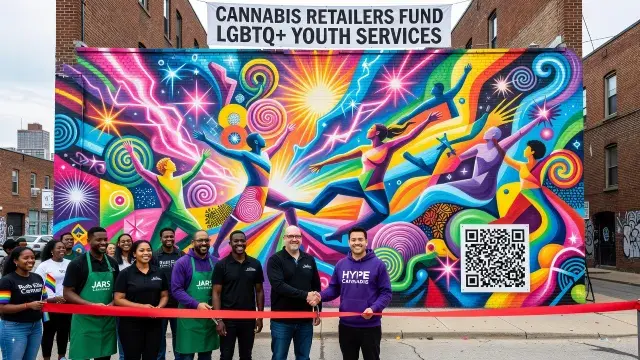
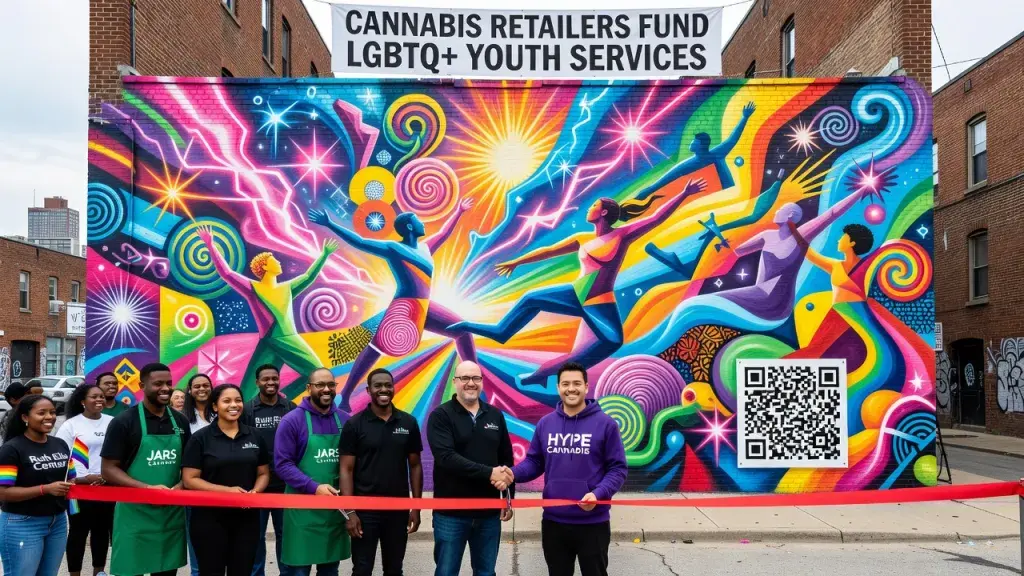
A ribbon-cutting in downtown Ferndale this week marked the debut of "Polychromatic Super You," a 40-by-25-foot mural by Michigan artist Joey Salamon, installed in the alley at 258 W. Nine Mile Rd. The piece was commissioned jointly by JARS Cannabis and HYPE Cannabis, and it doubles as the visual anchor for the two companies' Smoke with Pride campaign, which channels proceeds toward Detroit's Ruth Ellis Center. That's not a small distinction. Public art tied to a cannabis brand is still relatively rare in Michigan's adult-use market, and it says something about how retailers are trying to position themselves as neighborhood fixtures rather than just storefronts moving product.
The mechanics of the campaign matter here as much as the mural itself. Ten percent of proceeds from HYPE products sold at JARS locations, and the full proceeds from a co-branded Smoke with Pride kit, go to the Ruth Ellis Center, which serves at-risk LGBTQ+ youth in the region. Structuring a charitable give-back this way requires clean SKU management and accurate sales attribution at the point of sale - a retailer can't credibly promise a percentage of proceeds from a specific product line without a system that tracks those transactions separately from general basket sales. That's the kind of back-end discipline that platforms like indica software are built to support, since dispensary point-of-sale and inventory systems increasingly need to isolate promotional SKUs, tie them to compliant reporting, and reconcile donation totals without creating headaches for accounting or 280E-related recordkeeping.
Why Cause Marketing Carries Extra Weight in Cannabis
Cannabis operators face advertising and marketing restrictions that most retail categories don't. Cause-based campaigns like this one tend to draw less regulatory friction than product-focused promotions, but they still have to be handled carefully. A mural funded by two licensed cannabis retailers is, functionally, brand marketing in public space, even if the message is about community support rather than a specific product or strain. Local zoning and sign ordinances, along with state advertising rules on cannabis-adjacent messaging, generally shape what's permissible for outdoor art tied to a licensed business. Ferndale's approval of the mural suggests the city viewed it as public art first and brand promotion second, but that distinction is one other municipalities weigh differently, and operators elsewhere shouldn't assume the same latitude.
The QR Code as a Compliance-Friendly Bridge
The mural includes a QR code linking to donation information and campaign resources rather than to a menu or online ordering page. That's a meaningful choice. Keeping the call-to-action focused on a nonprofit rather than a retail transaction sidesteps a lot of the gray area around cannabis advertising to general audiences, including minors who might walk past the alley without any age-gating in place. For operators thinking about similar public-facing campaigns, routing digital engagement toward education or charitable giving, instead of direct sales, is a lower-risk way to build visibility without triggering the kind of scrutiny that follows more direct promotional tactics.
What Other Operators Might Take From This
Cannabis companies have leaned on cause marketing before, but pairing it with commissioned public art adds a physical, lasting presence that a social media post doesn't offer. It also creates an ongoing accounting obligation: proceeds tied to a cause need to be tracked, reported, and eventually verified, which means the campaign's credibility depends on execution long after the ribbon is cut. For multi-location operators weighing something similar, the real work isn't the unveiling - it's making sure the point-of-sale data, tax reporting, and donation reconciliation hold up months down the line.