A Connecticut cannabis consumer can walk into a dispensary, buy a product from a brand that has never appeared in a political headline, and still help fund a supply chain tied to millions of dollars in contributions benefiting Donald Trump's political allies. That is not a hypothetical. It is the practical reality of a market built on multistate operators, joint ventures, licensing arrangements and brand partnerships that rarely show up on the label.
What federal filings actually show
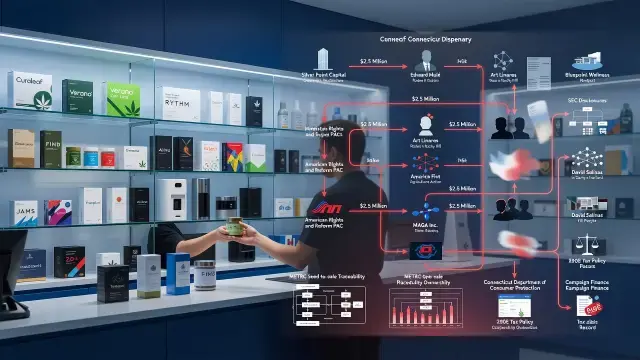
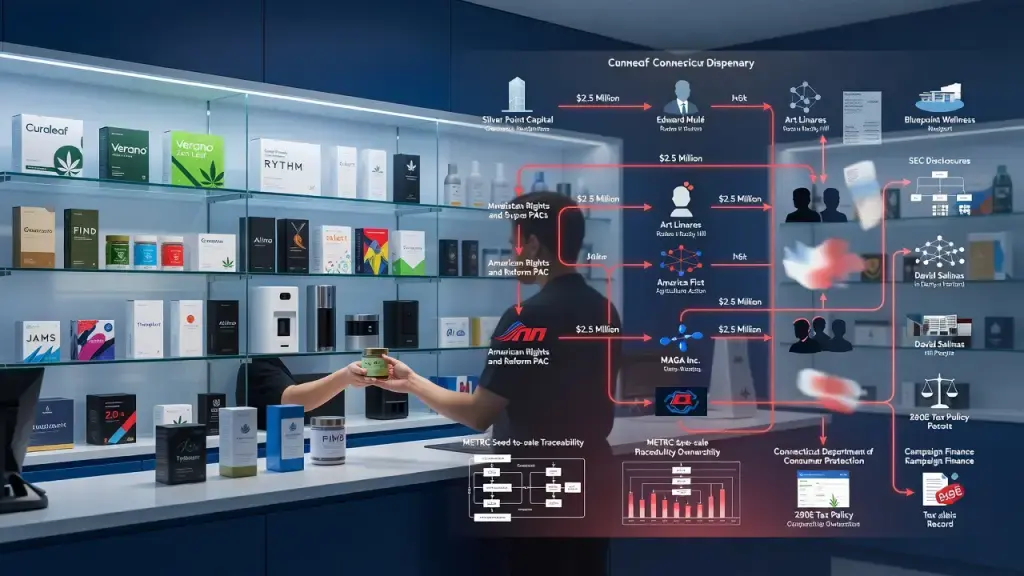
Federal Election Commission records document that American Rights and Reform PAC, a federal super PAC, received contributions during the 2025-2026 cycle from individuals associated with cannabis companies operating in Connecticut, including Verano, Green Thumb Industries, Curaleaf and Trulieve. That committee later sent $2.05 million to MAGA Inc., Trump's principal super PAC - a transfer reported by Marijuana Moment and confirmed in FEC disclosures.
In June 2026, the picture sharpened further. Curaleaf, Trulieve, Verano Holdings and Vision Management Services - a Green Thumb Industries affiliate - each contributed $2.5 million to a separate committee, America First Agriculture Action. That committee's treasurer, Charles Gantt, also serves as treasurer of MAGA Inc., according to Marijuana Moment's reporting. American Rights and Reform PAC separately moved $1.5 million into that same committee. The money passed through intermediary committees rather than going directly from any single cannabis company to Trump's operation - a distinction that matters for accuracy, even if the end destination is clear enough.
Why would multistate operators spend this way? Federal rescheduling remains the biggest policy lever in the industry, with direct implications for 280E tax treatment and the deductions these companies are currently denied. Political access is a business expense, not a sideline.
One storefront, many supply chains behind it
Here's the catch for anyone trying to shop around a political concern: Connecticut retail banners rarely match the full ownership structure behind them. Curaleaf's branded stores in Meriden, Stamford, Groton and Manchester are just one entry point; its products also move through Higher Collective, Cookies x The Goods in Hartford, and brands like Select, Grassroots, FIND and JAMS. Verano's Zen Leaf stores carry CTPharma, Savvy, Encore and On the Rocks. Green Thumb Industries holds a 46 percent stake in Bluepoint Wellness of Westport, which operates Venu Flower Collective, while its RYTHM, Good Green, Dogwalkers and incredibles brands circulate through other Connecticut shelves entirely.
A customer avoiding one retail name can still end up purchasing a product traceable to that same company under a different brand. Connecticut's Department of Consumer Protection maintains a cannabis portal and product registry that lists producers, but cross-referencing that against corporate parent structures and campaign-finance filings is not something a dispensary shelf tag is built to do.
Ownership trails that run through Greenwich and beyond
Not every connection in this story is a corporate super PAC check. Theraplant, a Connecticut cultivator sold under the Theraplant and All Hours brands, went through a strict foreclosure process in 2023 involving DXR Finance after its former parent, Greenrose Holding Company, ran into financial trouble - documented in SEC filings. Silver Point Capital, the Greenwich investment firm led by Edward Mulé, was part of the lender structure. Mulé's personal political giving, per federal records, includes contributions to Marco Rubio, Kelly Ayotte, Pat Toomey, Tom Cotton, Lee Zeldin and other Republican campaigns, and the Washington Post identified him among Wall Street donors who backed Kelly Loeffler and David Perdue in Georgia's 2020 Senate runoffs. None of that establishes that Theraplant itself made political contributions - but it is part of the financial structure standing behind the product.
Closer to home, Rodeo's co-founder Art Linares is a former Republican state senator who served as an alternate delegate pledged to Trump at the 2016 Republican National Convention and contributed $5,000 to a Connecticut Republican PAC in 2020. Rodeo's Rocky Hill operation also connects to the Airo and Tyson 2.0 brands found in state product registries. Hi! People, operating dispensaries in Derby and Hartford, is owned by David Salinas, who has publicly expressed support for Trump - a different category of connection than a corporate PAC transfer, but relevant to consumers weighing an owner's public political record.
Transparency the market doesn't currently offer
None of this means every retailer carrying a given brand shares responsibility for that brand owner's political spending, and it would be unfair to treat a budtender's employer the same as a multistate operator's C-suite. But the gap between what a dispensary's signage suggests and what its supply chain actually funds is real, and closing it currently requires piecing together FEC filings, SEC disclosures, state product registries and corporate ownership records - work that no single regulator or retailer is obligated to do for the customer.
- Check Connecticut's cannabis product registry to identify the licensed producer behind a specific product, not just the retailer's name.
- Treat brand partnerships and retail banners as separate from corporate ownership - they frequently are.
- Recognize that political contributions from cannabis companies often flow through intermediary PACs, which complicates but does not erase the financial connection.
A regulated market was supposed to make this easier than the illicit one it replaced - identifiable licensees, lab-tested batches, traceable products through seed-to-sale systems like METRC. It has delivered on product traceability. It has not delivered on financial traceability. Until Connecticut or its licensees close that gap, buying legal cannabis in the state may mean funding political interests a consumer never intended to support.