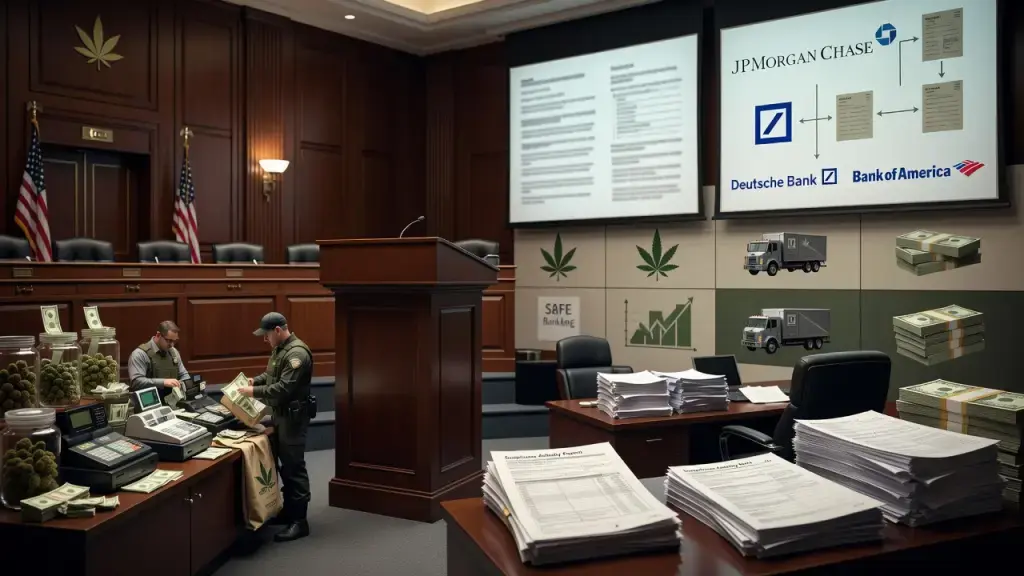
Incoming Senate Finance Committee Chairman Ron Wyden, D-Ore., said Wednesday he intends to use subpoena power to investigate banks that handled money tied to Jeffrey Epstein. The target list reportedly includes JPMorganChase, Deutsche Bank and Bank of America, all accused of failing to flag suspicious transfers connected to Epstein's financial network. On its face, this looks like a story about elite banking failures and congressional oversight. For cannabis operators, though, it lands closer to home than it might seem.
Why Bank Oversight Matters to a Cash-Heavy Industry
Here's the connective thread: the legal cannabis trade has spent nearly a decade begging for the same banks under scrutiny - and thousands of smaller ones - to simply take its deposits. Federal law still treats cannabis as a Schedule I substance, which means banks that serve state-licensed dispensaries, cultivators or processors face theoretical exposure under anti-money-laundering statutes. Most large institutions have avoided the sector entirely rather than build out the compliance infrastructure required to monitor plant-touching accounts.
That caution has pushed much of the industry toward cash-intensive operations, armored transport for tax payments, and a patchwork of smaller community banks and credit unions willing to accept the regulatory burden. Suspicious Activity Reports, enhanced due diligence, and ongoing transaction monitoring are already standard practice for the few institutions that bank cannabis money. The irony, if Wyden's probe gains traction, is that the same banks criticized for looking past red flags tied to an infamous offender have also justified their absence from cannabis banking by citing an abundance of compliance caution.
What a Congressional Probe Could Expose About Bank Risk Appetite
A Senate Finance Committee investigation with real subpoena teeth would pull back the curtain on how major banks actually weigh risk versus relationship value. If JPMorganChase, Deutsche Bank or Bank of America are shown to have overlooked clear red flags for a high-profile client, it undercuts the industry's long-standing argument that cannabis businesses are simply too risky to bank. In practice, the decision to decline cannabis accounts has often had less to do with genuine money-laundering risk and more to do with reputational caution and uneven federal guidance.
That distinction matters for multi-state operators and small dispensary owners alike. Banking access shapes everything from payroll processing to how a retailer handles its 280E tax burden, since federal tax code still denies standard business deductions to companies trafficking in a federally controlled substance. Operators without reliable banking relationships face higher costs for cash handling, fewer options for merchant payment processing, and greater exposure to inventory shrinkage and theft tied to large on-site cash reserves.
The Policy Backdrop: SAFE Banking Still Stalled
Congress has debated the SAFE Banking Act for years without passing it into law, leaving cannabis retailers dependent on a shrinking pool of willing financial institutions. A heightened congressional spotlight on bank compliance failures - even one rooted in an unrelated scandal - could shift the broader conversation about how banks assess risk tolerance for legal but federally unrecognized industries.
- Dispensaries still rely heavily on cash due to limited banking access
- 280E continues to restrict standard tax deductions for cannabis businesses
- Compliance costs for banks serving cannabis remain high relative to deposit size
- SAFE Banking legislation remains unresolved despite repeated congressional attempts
Whether Wyden's investigation produces findings that spill into the cannabis banking debate remains uncertain. What's clear is that any serious reckoning over how major banks evaluate client risk will not stay contained to one scandal. Dispensary operators, compliance officers and payment providers would do well to watch the hearings closely, not for the Epstein details themselves, but for what they reveal about the inconsistent standards banks apply when deciding who gets a checking account and who doesn't.