
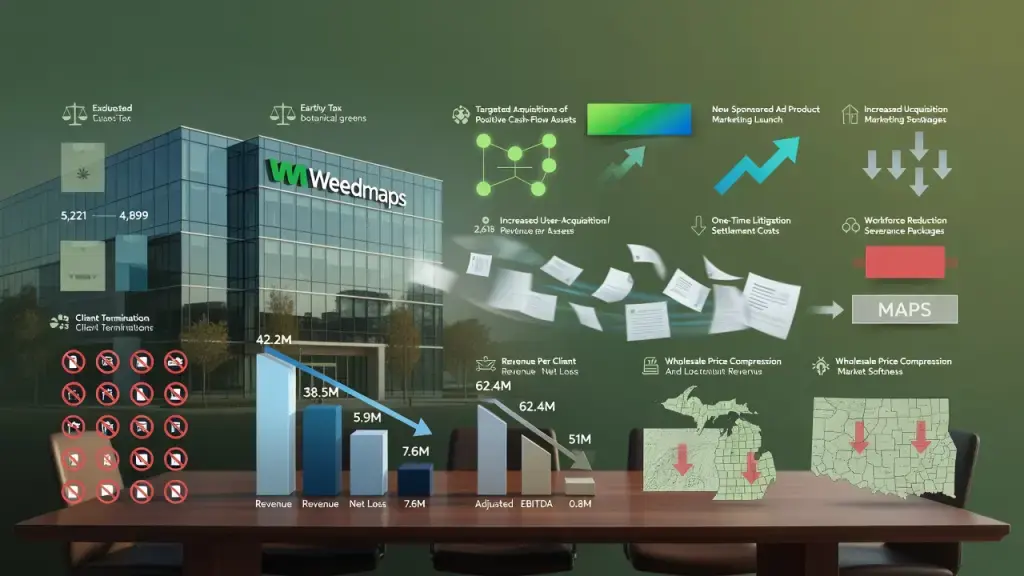
WM Technology, the Irvine, California-based company behind the Weedmaps marketplace, posted weaker third-quarter 2026 results, with revenue falling to $38.5 million from $42.2 million a year earlier. The company also swung to a net loss of $5.9 million, compared with net income of $3.6 million in the prior-year period. The drop, executives say, traces back to a deliberate decision to cut loose paying clients who fell behind on bills.
Collections Discipline Collides With Top-Line Pressure
CFO Susan Echard was direct about the cause: client payment difficulties. Average monthly paying clients fell to 4,899 from 5,221, and average monthly revenue per client slipped to $2,618 from $2,693. In plain terms, WM Technology terminated dispensary and brand accounts that were late on invoices rather than carry the receivable risk. That's a defensible move for a B2B platform whose revenue depends on cannabis retailers and brands actually being able to pay their advertising and software bills - and in markets suffering from wholesale price compression, not every client can. The company says some churned accounts may return, betting that platform dependency outlasts short-term cash constraints. Markets singled out as soft - Michigan, Colorado, and Oklahoma - share a familiar pattern across the regulated cannabis retail sector: heavy license issuance, falling wholesale prices, and thinning margins for storefront operators trying to cover excise tax, compliant packaging costs, and rent.
Adjusted EBITDA Compression and Where the Cash Went
Adjusted EBITDA fell sharply to $0.8 million from $7.6 million, and cash on hand dropped to $51.0 million from $62.4 million at year-end 2025. Management attributes much of the spend to increased user-acquisition marketing, plus one-time items: a securities litigation settlement and severance tied to a third-quarter workforce reduction. For a marketplace operator, heavier marketing spend is a wager that more consumer traffic converts into renewed client subscriptions and ad revenue down the line. CEO Doug Francis framed the quarter as "optically" weak but operationally constructive - a framing investors and clients alike will want to test against actual fourth-quarter numbers, since guidance points to only a low-single-digit revenue decline from Q3, not a rebound.
Delisting, Deregistration, and a Supply Chain Pivot
The more consequential development may be structural. WM Technology voluntarily delisted from Nasdaq earlier in the year and is moving to deregister as an SEC reporting company, now trading over-the-counter under the ticker MAPS. The stated rationale is reduced administrative and compliance overhead - fair enough, public-company reporting is expensive - but it also removes a layer of public disclosure that institutional investors and some clients rely on to assess counterparty risk. Francis said the company intends to use that operating latitude to expand deeper into the cannabis supply chain, targeting what he called "best-in-class assets" generating positive cash flow at reasonable multiples. No targets were named. For retailers and brands that depend on Weedmaps for advertising and compliant marketing tools, the practical question is whether a leaner, less transparent WM Technology becomes a more aggressive consolidator in the ad-tech and commerce layer of cannabis retail, or simply a smaller company managing decline.
What Operators Should Watch
- Client terminations for non-payment may tighten ad budgets at a platform many dispensaries use for discovery and order-ahead traffic.
- Persistent softness in Michigan, Colorado, and Oklahoma reflects broader price compression affecting licensed operators' marketing budgets in mature markets.
- A new sponsored ad product for brands, launching this month, is positioned as a near-term revenue lever worth monitoring for cost and placement terms.
- Deregistration reduces public financial disclosure, a relevant factor for clients and partners evaluating the platform's stability.